

Last reviewed: October 2026. This article is for general information and is not medical advice.
“Longevity” is one of the most popular words in wellness right now, and infrared sauna is often sold as part of it. Some claims you will see online are well supported. Others run well ahead of the science.
This guide separates the two. We looked at the main published research, explain what it does and does not show, and tell you where infrared sauna realistically fits. We manufacture infrared saunas, so we have a reason to be enthusiastic. That is exactly why we think you deserve an honest account.
The Short Answer
- The best known “sauna and longevity” research comes from traditional Finnish saunas, not infrared cabins.
- Those studies found that men who used saunas more often had lower rates of heart-related death, all-cause death, and dementia. They are observational, which means they show an association, not proof of cause.
- Research on infrared saunas specifically is smaller and shorter. It looks promising for blood pressure, heart failure, and chronic pain, but the evidence is limited.
- Infrared sauna is not proven to extend lifespan. It is best seen as a supportive, relaxing habit that sits alongside sleep, exercise, and good food.
What “Longevity Research” Actually Means
Two kinds of studies get mixed up in online discussions:
- Observational studies follow large groups of people for years and look for patterns. They can show that people who do X tend to have outcome Y. They cannot prove that X caused Y, because those people may differ in other ways.
- Clinical trials test a specific intervention over a defined period. They are better at showing cause, but are usually smaller and shorter, so they rarely answer “does this help people live longer?”
Almost all the headline sauna and longevity claims come from the first type.
The Finnish Sauna Studies
The most cited work follows 2,315 middle-aged men from eastern Finland, aged 42 to 60 at the start, for a median of about 20.7 years. Researchers compared men by how often they used a sauna.
A paper in JAMA Internal Medicine (2015) reported these differences compared with men who used a sauna once a week:
| Outcome | 2 to 3 sessions a week | 4 to 7 sessions a week |
|---|---|---|
| Sudden cardiac death | 22% lower | 63% lower |
| Fatal coronary heart disease | 23% lower | 48% lower |
| Fatal cardiovascular disease | 27% lower | 50% lower |
| Death from any cause | 24% lower | 40% lower |
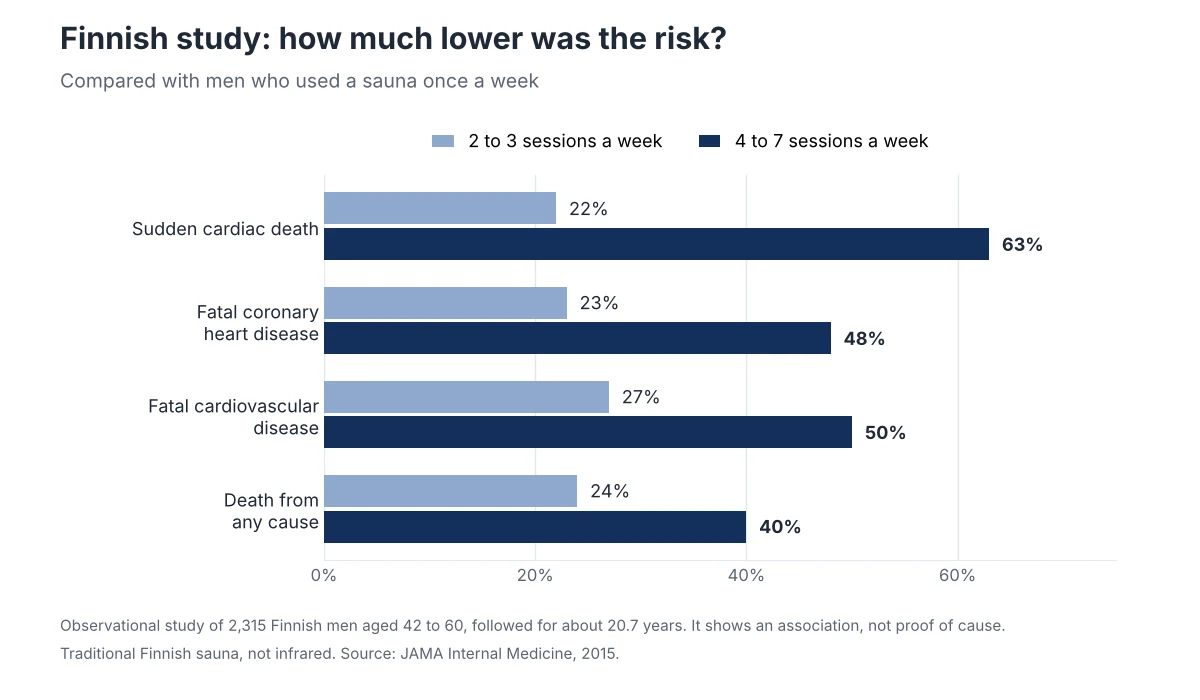
The same results as a chart. Source: JAMA Internal Medicine, 2015.
Longer sessions were also linked with lower sudden cardiac death risk, with the largest difference seen in sessions over 19 minutes compared with those under 11 minutes.
The same group of men was later studied for brain health. A paper in Age and Ageing found that men using the sauna 4 to 7 times a week had a much lower risk of dementia and Alzheimer’s disease than once-a-week users, and 2 to 3 times a week showed a smaller difference. The study recorded 204 dementia cases and 123 Alzheimer’s cases during follow-up.
These are striking numbers. Here is why you should still read them carefully.
Why These Results Come With Caveats
It is an association, not proof. The authors themselves say more research is needed to establish the mechanisms and to confirm the findings in other populations. People who use saunas often may also have other habits or circumstances that affect their health, and statistics can only adjust for so much.
It studied Finnish men. The participants were men from one region of Finland, where sauna is a lifelong cultural habit. The results may not carry over directly to women or to Indian lifestyles, climate, and health profiles.
It was not an infrared sauna. Traditional Finnish saunas run much hotter than an infrared cabin, which typically operates at around 45 to 60 degrees Celsius. Nobody can honestly say that infrared sauna produces the same results.
This last point is the one most often skipped in marketing.
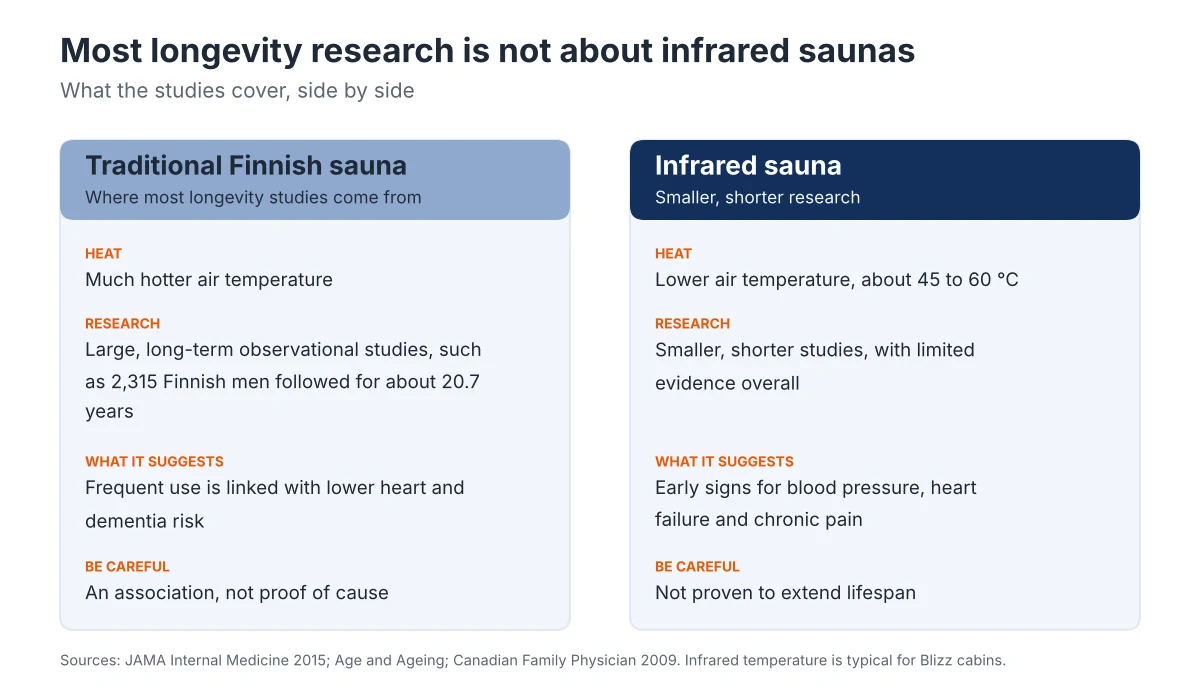
Most longevity research is on traditional Finnish saunas, not infrared cabins.
What the Research Says About Infrared Sauna Specifically
A 2009 review in Canadian Family Physician by Dr. Richard Beever looked at 9 relevant papers on far infrared saunas. Its conclusions were measured:
- Blood pressure and congestive heart failure: limited, moderate evidence of benefit.
- Chronic pain: fair evidence, but from a single study.
- Chronic fatigue and obesity: weak evidence.
- Cholesterol: consistent fair evidence that refutes claims of a benefit.
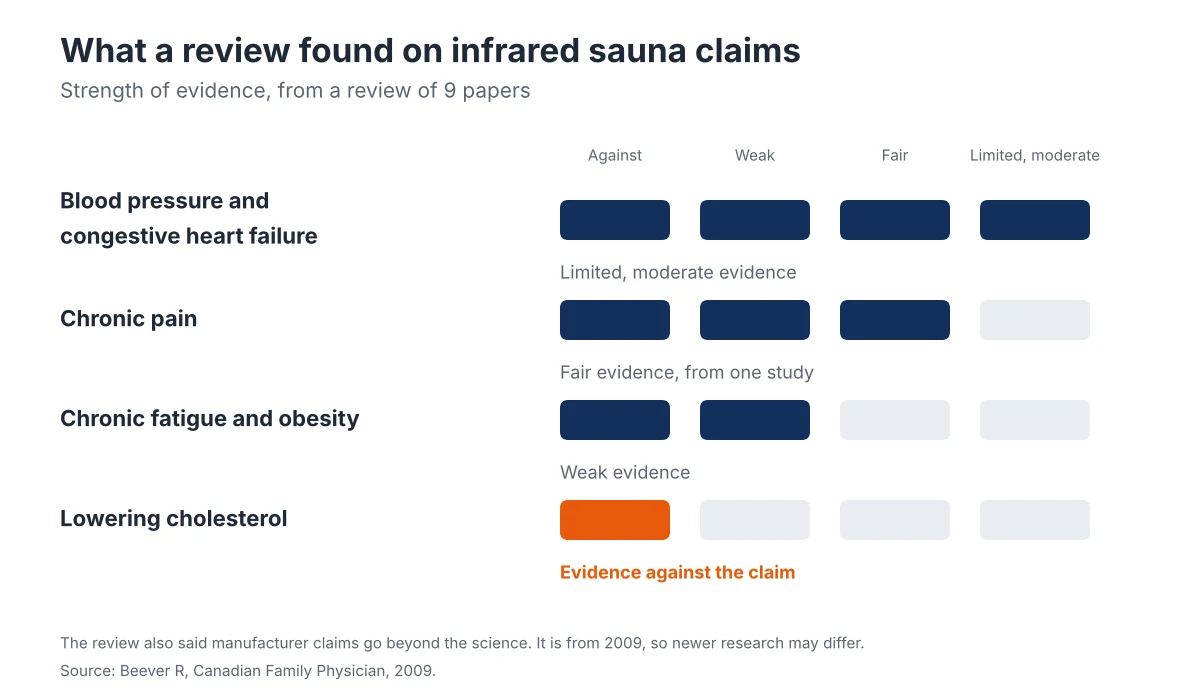
Strength of evidence by claim. Source: Beever R, Canadian Family Physician, 2009.
The review also noted that manufacturer claims go beyond what the science supports. We think that is a fair warning, and it is the reason we keep our own content careful. For a realistic view on one popular claim, read Infrared Sauna for Weight Loss: What It Can and Cannot Do.
This review is from 2009, so look for newer research too. The honest summary is that infrared sauna has some encouraging early evidence in specific areas, and nothing yet that proves it extends life.
How Heat Might Support Health
A 2018 review in Mayo Clinic Proceedings looked at sauna bathing more broadly, covering observational studies and trials through early 2018. The authors suggest several ways regular heat exposure might help, including better function of the blood vessel lining, reduced arterial stiffness, and lower blood pressure. They also pointed to areas that are still uncertain.
In plain terms, a sauna session raises your heart rate and increases blood flow, a little like light exercise. That is why many people describe it as a “passive cardio” effect. It is also why people with certain heart conditions need to be careful, which we cover below.
What This Means in Practice
You do not need to treat any of this as a prescription. These points are a sensible reading of the evidence:
- Consistency matters more than intensity. The Finnish studies looked at regular, repeated use, not occasional long sessions. A comfortable 30 to 40 minute session a few times a week is easier to sustain than anything extreme.
- Comfort is part of the point. Infrared heat warms the body at a lower air temperature, so many people find longer, more relaxed sessions easier than in a hot, humid steam room. See our comparison: Infrared Sauna vs Steam Bath.
- Sauna is an add-on, not a foundation. Sleep, regular movement, a balanced diet, not smoking, and routine health checks do far more for longevity than any single therapy.
- Hydrate and build up gradually. Drink water before and after, and start with shorter sessions.
For a broader, practical overview of benefits, read 8 Infrared Sauna Benefits for Body and Mind.
What Infrared Sauna Cannot Do
To be clear and fair, there is no good evidence that an infrared sauna can:
- Extend your lifespan on its own
- Lower cholesterol
- Replace exercise, medication, or medical care
- Treat or cure a disease
If anyone promises these, treat the claim with caution.
Who Should Check With a Doctor First
Talk to your doctor before starting regular sauna use if you:
- Have a heart condition, or very low or uncontrolled high blood pressure
- Are pregnant
- Take medication that affects blood pressure or sweating
- Have any serious medical condition
Never use a sauna after alcohol, and stop if you feel dizzy or unwell.
For Practitioners and Longevity-Focused Clinics
If you work in functional, integrative, or longevity medicine, infrared sauna is best positioned as a supportive, complementary offering that patients can enjoy consistently, not as a longevity treatment. That honest framing protects your credibility and your patients.
We explain how it fits into a clinical setting in Infrared Sauna for Ayurvedic and Naturopathy Clinics. We also take part in the functional medicine community’s annual meeting: Blizz at ISSMTCT 2026. If you are planning a wellness or recovery space, see How to Start a Wellness Centre in India.
Thinking of Adding an Infrared Sauna?
If you want to explore a home or commercial setup, these pages help:
- Infrared Sauna Price in India: Complete Cost Guide
- Infrared sauna for your home
- Explore all Blizz models
To talk to our team, call or WhatsApp +91 98250 38480 or fill the inquiry form. We respond within 24 hours.
FAQ’s
Does infrared sauna help you live longer?
There is no proof that it does. Large Finnish studies link frequent traditional sauna use with lower rates of heart-related death and dementia, but those studies are observational and did not test infrared saunas. Infrared sauna is best seen as a supportive habit, not a lifespan treatment.
Do the Finnish sauna results apply to infrared sauna?
Not directly. Finnish saunas run much hotter than infrared cabins, and the studies were conducted in Finnish men. Infrared has its own, smaller body of research, mostly looking at blood pressure, heart failure, and chronic pain.
How often should I use an infrared sauna?
The Finnish studies looked at regular use, ranging from once a week to several times a week. A comfortable 30 to 40 minute session a few times a week is a reasonable, sustainable pattern for most healthy adults. If you have a medical condition, ask your doctor first.
Can infrared sauna replace exercise?
No. A sauna session raises your heart rate a little, similar to light activity, but it does not replace the strength, fitness, and metabolic benefits of regular exercise.
Is infrared sauna safe to use every day?
Many healthy adults use it daily, but it depends on your health. Stay hydrated, keep sessions comfortable, and check with your doctor if you have a heart condition, blood pressure problems, are pregnant, or take regular medication.
Sources
- Finnish sauna and mortality study, JAMA Internal Medicine, 2015: summary from the American College of Cardiology
- Laukkanen T, Kunutsor SK, Kauhanen J, Laukkanen JA. Sauna bathing is inversely associated with dementia and Alzheimer’s disease in middle-aged Finnish men. Age and Ageing: study record
- Laukkanen JA, Laukkanen T, Kunutsor SK. Cardiovascular and other health benefits of sauna bathing: a review of the evidence. Mayo Clinic Proceedings, 2018: PubMed
- Beever R. Far-infrared saunas for treatment of cardiovascular risk factors: summary of published evidence. Canadian Family Physician, 2009: PubMed
- University of British Columbia News, 2016: Are infrared saunas healthy?
Blizz Infrared Sauna is India’s No. 1 far infrared sauna manufacturer, with 500+ installations across homes, gyms, spas, hotels, and wellness centres. Explore our models