
Last reviewed: November 2026. This article is for general information and is not medical advice.
If you are choosing between an infrared sauna and a traditional sauna, you will hear strong opinions on both sides. Traditional sauna fans point to centuries of Finnish tradition. Infrared fans point to lower temperatures and easier installation.
We manufacture infrared saunas, so we are not neutral. We have tried to make this comparison fair anyway, including the parts where traditional saunas have the stronger research. Here is what actually differs, and how to decide.
The Short Answer
- A traditional sauna heats the air in the room, usually to around 66 to 93 degrees Celsius. An infrared sauna warms your body more directly and runs much cooler, around 43 to 57 degrees Celsius.
- Most of the well known longevity and heart research was done on traditional Finnish saunas, not infrared cabins.
- Infrared saunas are usually easier to install in Indian homes, since they need no stones, steam, or special ventilation.
- Neither is proven to be better for health. The right choice depends on your comfort, space, budget, and goals.
How Each Type Works
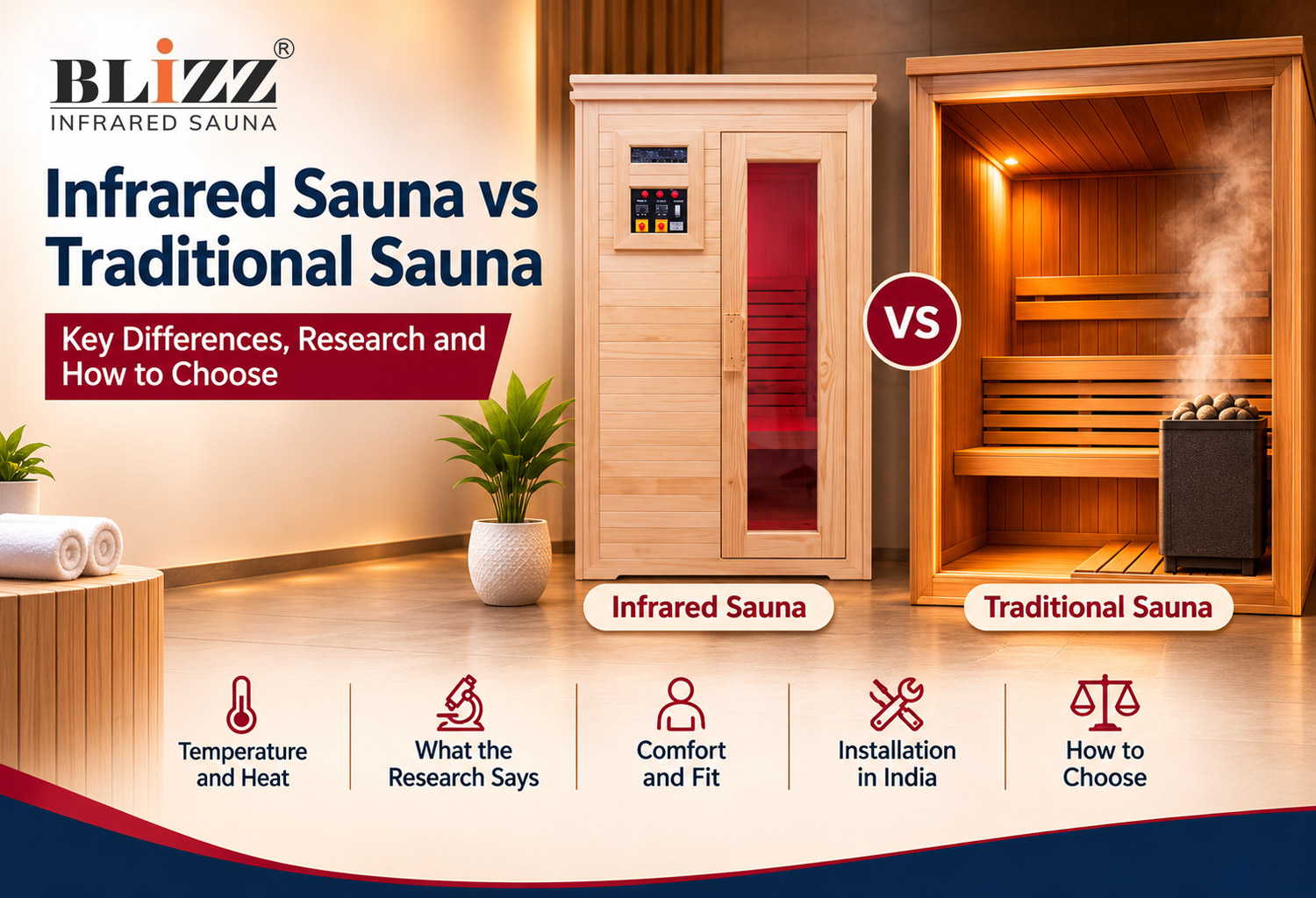
Traditional sauna. A heater, powered by wood, gas, or electricity, warms the air and a pile of stones. Water is often poured over the stones to create bursts of steam. The air in the cabin gets very hot, and that hot air warms your body.
Infrared sauna. Carbon or ceramic heating panels give off infrared heat that warms your body directly, rather than mainly heating the air. There is no steam, and the cabin stays cooler. Cleveland Clinic describes it this way: infrared panels warm the body itself, and there is no steam or flame-stoked heat inside.
Side by Side
| Factor | Traditional sauna | Infrared sauna |
|---|---|---|
| Cabin temperature | About 66 to 93 degrees Celsius | About 43 to 57 degrees Celsius |
| How it heats | Heats the air and stones | Warms the body directly with infrared panels |
| Humidity | Dry, with steam bursts if you add water | Dry, no steam |
| Warm-up time | Often longer, since the room and stones must heat up | Usually shorter |
| Typical session | Often shorter, because the heat is more intense | About 15 to 30 minutes |
| Installation | Needs more space, a heater and stones, and good ventilation | Plug-in style cabins that fit into a room |
| Running needs | Depends on heater type and size | Depends on the cabin and heater setup |
| Research base | Large, long term Finnish studies | Smaller and shorter studies |
| Best for | People who enjoy intense heat and steam | People who prefer gentler heat and easy setup |
Temperature and session figures are from Cleveland Clinic. Your own experience can vary with the cabin and how it is set.
What the Research Says
This is the most misunderstood part of the comparison.
Traditional saunas have the bigger research base. The best known study followed 2,315 middle-aged Finnish men for about 20 years and found that men who used a sauna more often had lower rates of heart-related death and all-cause death. A related study found lower rates of dementia. Those are observational studies in Finnish men using traditional saunas. They show an association, not proof of cause. We cover them in detail in Infrared Sauna and Longevity: What the Research Actually Says.
Infrared research is smaller. A 2009 review of far infrared saunas found limited, moderate evidence for blood pressure and heart failure, fair evidence for chronic pain from a single study, and weaker evidence for other claims. A Cleveland Clinic physician speaking on its podcast describes the evidence for infrared as fairly strong in some areas, such as heart function, while noting that researchers are always looking for more. Reading both, the honest summary is that infrared research looks promising in specific areas, but it is not as large or long term as the Finnish work.
What this means for you. Nobody can honestly say that an infrared sauna will give you the same results as the Finnish studies. If your main goal is the research behind traditional sauna, a traditional sauna is the closer match. If your main goal is a comfortable, regular heat habit, the best sauna is the one you will actually use.
Comfort and Who It Suits
Many people find infrared easier to enjoy. Because the air is cooler, people who do not like very hot, steamy rooms often find infrared more comfortable, and it can be easier to sit through a full session. We compare it with steam in Infrared Sauna vs Steam Bath.
Some people prefer traditional. If you love intense heat, the ritual of adding water to the stones, and a short, hot session, a traditional sauna offers that experience. An infrared cabin will not feel the same.
Installation and Practicality in India
This is where many Indian buyers decide.
- Space. Infrared cabins come in compact sizes. A 4′ x 4′ cabin needs about 36 sq ft of floor area.
- Setup. A home infrared cabin typically runs on a standard 16 amp point and needs no plumbing, stones, or chimney. Traditional heaters often need more electrical capacity, more ventilation, and more planning. Ask any seller for the exact requirement and have an electrician check your wiring.
- Apartments. Infrared is generally the easier fit in flats and gated communities.
- Businesses. Gyms, spas, and clinics often choose infrared for its smaller footprint and simpler setup. See our guides for gyms and spas and resorts.
Safety Applies to Both
Both types make you sweat and raise your heart rate, so the same precautions apply. Drink water, start with short sessions, avoid alcohol, and skip the sauna when you are ill or feverish. Pregnancy, heart conditions, blood pressure problems, and regular medication are all reasons to speak to your doctor first. Read our full guide: Infrared Sauna Safety and Side Effects.
So Which Should You Choose?
An infrared sauna may suit you if:
- You prefer gentler heat and a cooler cabin
- You live in an apartment or have limited space
- You want a simple setup without stones, steam, or special ventilation
- You want a regular habit you can do at home
A traditional sauna may suit you if:
- You enjoy intense heat and steam
- You have the space and ventilation for it
- You specifically want the traditional Finnish experience
If you are still deciding on a cabin, our Infrared Sauna Buying Guide for India lists what to check about heaters, wood, wiring, and warranty. For costs, see the Infrared Sauna Price in India Guide.
What About Health Claims?
Be careful with promises from either type of seller. A sauna is not a detox treatment, a weight loss tool, or a way to treat disease. See Infrared Sauna and Detox: Fact vs Marketing, Infrared Sauna for Weight Loss, and 8 Infrared Sauna Benefits for Body and Mind for a realistic view.
Talk to Blizz
If you would like help choosing the right cabin for your home, gym, spa, or clinic, our team is happy to guide you.
Call or WhatsApp +91 98250 38480 or fill the inquiry form. We respond within 24 hours.
FAQ’s
What is the difference between infrared and traditional sauna?
A traditional sauna heats the air and stones, so the cabin gets very hot, often 66 to 93 degrees Celsius. An infrared sauna uses panels that warm your body directly and runs cooler, around 43 to 57 degrees Celsius.
Is infrared sauna better than traditional sauna?
Neither is proven better for health. Traditional saunas have more long term research, mostly in Finnish men. Infrared saunas run cooler and are easier to install, and many people find them more comfortable.
Do the Finnish sauna studies apply to infrared sauna?
Not directly. Those studies looked at traditional saunas, which run much hotter. Infrared has its own, smaller body of research.
Which is easier to install at home in India?
Infrared is usually easier. Home cabins typically run on a standard 16 amp point and need no plumbing, stones, or chimney. Check the exact requirement with the seller and have an electrician confirm your wiring.
How long should a session be?
For infrared, about 15 to 30 minutes is a common range. Start shorter and build up. Traditional sessions are usually shorter because the heat is more intense. Stop if you feel unwell.
Is infrared sauna safe?
For most healthy adults, short sessions with enough water are generally considered fine, but it is not right for everyone. Speak to your doctor if you have a medical condition or are pregnant.
Sources
- Cleveland Clinic Health Essentials podcast: The benefits of infrared saunas (temperatures, how each type heats, session lengths)
- Finnish sauna and mortality study, JAMA Internal Medicine, 2015: summary from the American College of Cardiology
- Laukkanen JA, Laukkanen T, Kunutsor SK. Cardiovascular and other health benefits of sauna bathing: a review of the evidence. Mayo Clinic Proceedings, 2018: PubMed
- Beever R. Far-infrared saunas for treatment of cardiovascular risk factors: summary of published evidence. Canadian Family Physician, 2009: PubMed
Blizz Infrared Sauna is India’s No. 1 far infrared sauna manufacturer, with 500+ installations across homes, gyms, spas, hotels, and wellness centres. Explore our models